Showing posts with label scifi. Show all posts

Monday, 28 September 2015

The Curse of Missing your #Genre

Genres are a tricky thing. Some are obvious and clear, others are fuzzy and wide-open to personal interpretation. There are many sub-genres out there that stir up heated debates around their definition. The more you look into the whole thing the more of a mess it seems to become.

I've always classified myself as a science fiction author. My first few novels were classic science fiction, or at least I thought they were. The fact that they form an on-going series of books, sharing a common scenario and characters pushes them into Space Opera, but then I write very accurate science with a decent attempt to realistically predict near future technology. That kind of makes my novels Hard SciFi.

For years I kept labelling my novels either Hard SciFi or Space Opera, but recently I am beginning to think I may have got it completely wrong. Yes I write epic, far-reaching stories with a large cast of characters and yes my stab at future technology is soundly based in current technological research, but those are NOT the most important aspects of my novels.

The science fiction is not the centre of the story or even the reason for it. Looking back, most of my novels would actually work just as well set in the 18th Century on board wooden ocean-going vessels. The stories would translate very well and there's very good reason for this.

Icarus


At the core of my novels is not science fiction, but humans. Everything revolves around the characters, their aims, fears, loves, fights and struggles. I've had several people tell me they believe Astronomicon: Icarus is based on the movie Event Horizon. It wasn't. I cannot claim that there is no crossover there, but my book was actually devised after watching The Perfect Storm (which was almost an excellent movie). I wanted to write a version which fixed the problems and, as I tend to write scifi, I wrote it as a scifi novel. In the end it diverged quite substantially from the plot of The Perfect Storm and went very much its own way.

By constantly labelling my novels as science fiction, and some of its sub-genres, I am probably losing a massive chunk of my potential reader base. I know of about a dozen people so far who have loved my books who openly state they do not like science fiction. My books have elements of mystery, action, adventure and even horror in them. They all contain some humour and even a little romance in places. My latest novel, Deadline (soon to be published) even has two of the key characters getting married before the final chapter. I planned it as a science fiction comedy, but it could easily be described as the account of a relationship from first meeting to eventual marriage. Maybe it's a RomCom? (No I don't think so!)

My stories are human stories, which happen to play out in a science fiction background. Which genre should I file them in? I genuinely don't know any more.

Thursday, 18 September 2014

Foundation for a Universe

Long before I started writing the first Astronomicon novel, I began planning the universe in which the stories are set. Although I always planned to write novels and short stories set within the Astronomicon universe, it was never the primary reason for creating such a large and detailed scenario. I was originally working on a computer game, a multi-player real-time strategy game where players choose which species to play, before setting about annihilating all the other species through space exploration, technological development and military proliferation.

After several attempts to create the game established that it was a far larger project than could be realised with my resources, I decided that the only practical way to proceed was to write novels set within the universe.

With 12 alien races planned out in detail, a wide range of technological development and a projection of Earth history covering the next 200 years, there was a huge amount of potential material for an exciting science fiction novel. The first problem was picking where to begin.

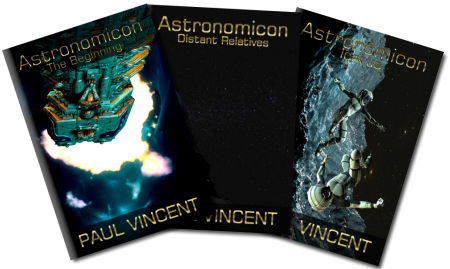
The most obvious place isn't always the most interesting, but in this case most of the potential stories were not going to make much sense unless I introduced the Astronomicon itself, the mysterious device which links all the books. More than that, the title of the entire series needed to be explained, otherwise it would seem oddly abstract. The best way to do that had to be to cover its discovery. Better still, the group of humans who discovered the Astronomicon itself had a back story which was ideal for some classic science fiction. The first book took shape, named Astronomicon: The Beginning, and covering the first interstellar space flight by humans, seeing them survive a concerted effort to thwart their mission to build the first extrasolar colony.

The second novel, Distant Relatives, seemed to be a natural progression, in that it was set immediately after the first one. It shifts the focus back to Earth and opens with a huge alien invasion of the solar system. We get our first taste of  more advanced technology and the human race begins to the see the bigger picture and how they fit into the universe. The colony from book one turns out to be a key element in the ongoing story, uncovering a plot with serious implications for the inhabitants of Earth.

By the end of the second book, my aim was that readers would have a clear measure of the starting technology level and be fully aware of the approaching threat, but would still have no real idea of what technology they might be up against in future. Readers would discover that Earth's history up to the present day is not quite we have been led to believe.

After the universe and style of technology were both established, that left me free to explore other stories. Astronomicon: Those Left Behind was originally a contender for launching the whole series, but I think it worked much better as a prequel to the whole story. It filled in the reason for the Eridani race travelling to Earth, revealed some of their motivations and, for the very first time, gave a sense of the scale of the alien threat. We see how the relentless invasion of their home-world and ruthless extermination of their population drive them to execute a vast and daring escape plan. Only a tiny percentage of the population have a chance of getting away, but millions have to make the ultimate sacrifice to make it possible.

I believe that this is the best novel I have written so far. The emotions and motivations of the central characters are stronger than ever before. The "hero" has to overcome fear itself, avoid an alien menace and even go against his own people to save his children from extermination. Although this book is very much a prequel to the first two novels in the series, it also works perfectly well as a stand-alone novel. It's a good way of trying out the Astronomicon series without committing to a series.


Thursday, 27 March 2014

Who thought different countries would buy my e-books so differently!

Astronomicon Science Fiction books
I have been assessing my book sales over the last twelve months.Variations are to be expected, but the shape of my sales statistics have been changing over the last twelve months much faster than I would have expected. The truly difficult part is working out why.

*For my analysis I'm only going to use sales in primarily English-speaking countries. I do sell a few books in Germany and France etc., but not enough to be statistically viable for analysis.

Astronomicon 1: The Beginning:

Last year this book was my bestseller in the US, but not any more. Now it sells best in Canada, with the UK coming a close second. US sales have become very weak and I have no idea what has changed.

Astronomicon 2: Distant Relatives:

This book's sales were always split down the middle between the US and the UK. The pickup rate from the first book to the second was markedly higher in the UK, but I always assumed that as I'm British, American readers might find my writing, especially dialogue, a little alien. Now it sells well in Canada and the UK but US sales have dwindled badly.

Astronomicon 3: Those Left Behind:

Annoyingly, this one was never a popular seller. I have always been a little depressed by that as I firmly believe it is the best piece of science fiction I have ever written so far. However it's Canadian sales have increased markedly over the past twelve months and US sales have all but stopped. UK sales have remained pretty static.

Astronomicon: Icarus:

By far my best selling book currently, but last year it was selling two copies in the UK for every one sold in the US. Now the US outsells the UK about 6 to 1. Canada also beats the UK hands down on this one and I have no idea why. It seems that:

  • Canadian readers buy this book and then go on to buy all the other Astronomicon books.
  • American readers buy this book with greater enthusiasm but most stop there.
  • British readers shy away from this one, instead preferring to begin with Astronomicon: The Beginning.

Conclusions:


Astronomicon: Icarus has benefited from an ongoing 99c offer which has clearly boosted its sales greatly. Maybe US readers are more easily swayed by a low price offer? 


If I could persuade US readers to buy my other books after purchasing Astronomicon: Icarus, that would fix my US sales issue. Equally if I could somehow make Icarus as popular in the UK as it is across the Atlantic that would also be a major boost.

Anyway, for now my focus is on writing Astronomicon: Deadline, another standalone novel within the Astronomicon universe. Once that is ready for publication I think I will have to sit back and reassess my marketing efforts. If with each book I write, I learn more, hone my skills and expand my reach into social networking then success can be eventually achieved without relying on luck. Marketing is important but it gets easier with more and better books to market.

Wednesday, 12 March 2014

Still holding the 99c (79p) #offer on #Kindle #novel Icarus

E-book sales can be unpredictable at the best of times. I'm sure a lot of Indie authors have seen surges and lulls in their book sales for no discernible reason, but dropping the price of  Astronomicon: Icarus to 99c (that's 79p here in the UK) on Amazon has been the most successful offer I've launched to date.

As I've said before, science fiction thriller Icarus has had good reviews and no bad ones but, better than that, almost everyone who buys it seems to go on to buy all the other Astronomicon books. That's the best vote of confidence I could ask for. I should take this opportunity to again say thank you to everyone who has taken the time to review my books. It's nice to get feedback, especially the positive kind, and it helps encourage other people to give my books a try.

The most bizarre thing I've experienced with Icarus is that almost all my sales are on the other side of the Atlantic. The US and Canada account for well over 90% of the worldwide sales. Prior to starting the 99c offer, about 60-65% of my book sales were here in the UK. Why Icarus appeals so strongly to those on the North American continent is a mystery to me. If anyone over there understands why Icarus is SO much more popular over there, please let me know.

You can check out Icarus on your local Amazon website, see more reviews on Goodreads.com or find out more about the whole of the Astronomicon science fiction series on the Official website.

Friday, 17 January 2014

Don't forget Icarus is still only $0.99

Whilst working the Trojan asteroid cloud, Captain Taylor and the crew of the deep space mining vessel Icarus discover a mysterious prototype ship drifting in space having suffered a catastrophic failure.

Battling the dangers of the asteroid field, the Icarus crew attempt to rescue the survivors of the stricken ship. Meanwhile a vessel from Earth is coming to deal with the damaged prototype but with a conflicting agenda. After unwittingly discovering the bizarre secret of the prototype vessel, the crew of the Icarus end up fighting for their very survival.


Although it's not the first book in the epic Astronomicon science fiction series, Icarus forms an excellent introduction to the Astronomicon universe. It is a stand-alone novel, but still firmly set in the same technologies, politics and history. It gives you an exciting taste of the Astronomicon universe without committing to the ongoing series.

99c US (or 77p here in the UK) is a bargain for over 160 pages of quality science fiction.

To find out more visit the official Astronomicon website or visit your local Amazon website. There are now four Astronomicon novels and another one on the way soon. The fifth novel, Astronomicon: Deadline should hopefully be published in the third or fourth quarter of 2014.

Monday, 9 December 2013

Is there too much new #scifi?

I've been writing and publishing science fiction for almost three years now. Science fiction has been my hobby and fascination for as long as I can remember, so when I started writing it seemed the obvious genre work within.

What I've learned from the last three years is that there are an incredible number of people writing science fiction novels and short stories, and probably just as many creating fan fiction for most of the well-known movies and television series.

I am coming to the conclusion that there's only limited space in the market and the huge number of science fiction writers out there is simply producing far too much material for the market. Up to a point the good stuff will float to the top, but I suspect that these days there is such a deluge of material that even some of the good stuff simply gets lost in the crowd. No-one can possibly be aware of everything that's published (and by that I am very much including the self-publishing world) so those authors without the marketing and promotion skills to draw attention to their work will tend to sink without trace, regardless of how good their writing is.

Short of persuading less people to write science fiction, I don't see any fix for this unfortunate situation.

Although my love of writing science fiction isn't about to end, I'm going to jump ship and try out another genre. What out "Crime Thrillers" - here I come!

Monday, 25 November 2013

Is it worth #publishing one chapter at a time?

Astronomicon: The Beginning
The world of indie publishing is a large and often complicated world. There are an ever increasing ways to publish your work and everyone seems to have different idea of what works. I suspect that different genres and formats are better suited to different methods and media, but are there any firm patterns emerging?

I've tried publishing e-books, paperbacks, short stories and even publishing one chapter at a time on Wattpad.com. The latter has been an interesting experience but I don't feel it's worked too well so far.

I decided to publish the whole of the first Astronomicon novel chapter-by-chapter on Wattpad.com, but rather than just cutting and pasting each chapter, after much research,  I went for a slightly different approach. I created shorter chapters by cutting each chapter into several shorter ones. This both catered for the tendency towards short attention spans online and gave me many more chapters to post. I am currently posting about five chapters per week so having more chapters extends the run time of the experiment. On Wattpad it seems that a lot of short chapters work better than a few long ones. I guess short instalments are more accessible and less of a commitment?

If you want to see this format, check it out on Wattpad.com. There are 25 chapters posted at the time of writing this. What I am most interested to see is the fall off rate of each chapter, to see how many people are still reading by the last chapter. It could prove to be a useful diagnostic tool as any poorly performing chapter, in terms of keeping the readers' attention, should stand out. This may allow me to improve the guilty chapters and increase the book's ability to grip readers.

I will report back soon.

Wednesday, 30 October 2013

#Sci-Fi Fans: #Free Chapter Every Day!


Eight chapters so far, but I'll be posting a new one every day until the whole book is posted. To avoid the wait (or just for convenience) download the whole book for your e-reader from Amazon for just 79p (99c).

Monday, 21 October 2013

Read a #free chapter every day

Here’s an excellent new way to read Astronomicon: The Beginning (1st novel in the epic sci fi series). Starting today I will be posting a free chapter every day until the whole book has been posted.

You can read the first chapter here. If you like it, please take a second to vote for it. It would be really nice to see some votes to go with the good reviews.

Tuesday, 1 October 2013

What's the best price for an e-book?

Astronomicon Science Fiction Novels
Having now tried a variety of price points, it looks like I'm going to move the price of the introductory Astronomicon (The Beginning) back to $0.99.

It's still selling at its current price of $3.99, but just not achieving the numbers I need. Although I am making slightly more money from selling fewer at the higher price, this has serious repercussions when you assess the whole series. Just over half the people who buy book 1 go on to buy book 2 (Distant Relatives) and almost all of those go on to buy Book 3 (Those Left Behind). Overall, lower sales of book 1 means less people get introduced to the series and I lose out.

There are so many factors to take into consideration when choosing a price for your novels and sometimes the only way to find out for sure is to try out the variants and see what works best for you.

If you want to find out more, try this article.

Wednesday, 21 August 2013

Progress on the Celtic Conveyor #3D #Model

      
It’s been a while since I posted a progress report on the Celtic Conveyor design. I'm really not getting much time to work on it, but Sketchup is such an easy package to use that it doesn't take much effort to put complex things together. Even without a concerted effort, the design is moving on at a decent pace.
Celtic Conveyor Interplanetary Freighter 3d design

More structure has been completed, all 24 cargo pods and now most of the upper deck too. The upper deck, known as the “Command Deck”, the focus of this shot above, houses the bridge, operations room, senior crew accommodation and the captain’s cabin and office.
Celtic Conveyor Interplanetary Freighter 3d design

This full-length shot clearly shows how almost two-thirds of the vessel’s length is taken up with the cargo pods, each almost 8 metres hight, 20 metres long and over 13 metres wide. Although the accommodation for passengers is a significant part of the vessel, it is at heart a freighter.
Celtic Conveyor Interplanetary Freighter 3d design

Another view of the accommodation section, from the rear. This highlights how much smaller the command deck is than the passenger deck. Behind the main airlocks on the passenger deck you will find the recreational and medical sections of the vessel. Due to voyages from Jupiter to Earth taking upwards of six weeks, the vessel, must include all facilities necessary to occupy and care for passengers and crew for the duration. This includes a sports hall, small gym, exercise area, doctor’s surgery, infirmary and comprehensive pharmacy.

The End is Nigh!

The 99c special offer on Astronomicon: The Beginning will be coming to an end this Sunday (25th August) and will returning to its usual price of $2.99.

Until Sunday you will still be able to download this 360+ page quality science-fiction novel from Amazon US for 99c (please check your local Amazon for the equivalent price in your region). Almost all devices can handle this e-book, including Kindles, PCs, Android devices and even iPhones and iPads.

"3 Space craft, 240 colonists, 25 trillion miles and an unexpected discovery that changes everything.

Classic science fiction that will appeal to fans of Arthur C. Clarke. Astronomicon: The Beginning follows the human race’s intrepid first steps into interstellar space, a colonisation mission to Proxima Centauri. The colossal distance and harsh environment are not all that stand between them and survival.”

Click here to find out more.

Saturday, 6 July 2013

Cover art for Astronomicon: Those Left Behind

Cover art for Astronomicon: Those Left Behind
This is the excellent front cover design for Astronomicon: Those Left Behind. I hope you'll all agree that this is one of the best designs for an Astronomicon cover. It follows the same basic template as the other three books in the Astronomicon series, but features just about the most eye-catching imagery so far.

In case you are wondering, the image shows a planet being bombarded from orbit. When invading another world it makes sense to take out as much of their defence systems as you can before even considering visiting the surface, and a basic orbital bombardment is usually the best way to achieve that.

This image shows the Eridani homeworld, shortly before the Cephali ground assault commences.

Wednesday, 12 June 2013

Astronomicon: The Beginning FREE TODAY!

Cover art of Astronomicon: The BeginningFor two days (today and tomorrow) Astronomicon: The Beginning is available as a free download from your local Amazon. Don't miss out on this excellent offer!

If you do miss the free offer, don't forget that you can always check out the first six chapters for free any time, buy using Amazon's amazing Click to LOOK INSIDE. You can also have the free sample chapters sent to your Kindle or compatible device (Android, PC, MAC or iOS) - it doesn't get much easier than that!