Showing posts with label writer. Show all posts

Sunday, 7 September 2014

OMG I'm going to Die!!

In an idle moment last night, I did some thinking about the future, more specifically MY future. I considered where I am in life right now and what I still hope to achieve. It's been a busy few years and I suspect I haven't given the subject any thought for a few years, probably over a decade.

And that's the problem. Time goes by, life is busy, work, chores, duties all seem to take up more and more time and many of the things I aim to do in the future are just as far away as they were ten years ago. This would be fine except I now have ten less years to achieve them. In fact, once I start thinking about it, I don't have all that long left to achieve them.

It's taken me over four decades to get where I am so far and I'm not even halfway through the list! How much time do I have left? Medical science is always advancing and I have no reason to assume I won't make 80, maybe 90, but beyond that? Okay so the way lifespans are increasing I might live to 120 or more, but will I still be effective and mentally sharp for most of that?

Then there's the element of luck. I could get run down and killed next time I cross a road. The next plane I fly on could be hijacked by a foreign power, flown to a secret airbase for a couple of weeks before being flown to an Eastern European country and then being blown up as though it was hit by an enemy missile. Okay, that one was a little convoluted, but I write science fiction thrillers, so what do you expect!?

However I go, I'm probably about halfway through my effective time on this planet. If I want to achieve the rest of my aims in life, I need to get a move on. Do I want to be lying on my death bed (or in a burning airliner plummeting to the ground) thinking about all the stuff I always wanted to achieve but never even tried?

Stop procrastinating. If you want to achieve something, start work on it!

Monday, 28 April 2014

#Marketing: More important than #Writing?

To be honest I wonder if that has always been the case. There are many, many authors out there all clamouring to get their works in front of as many readers as possible. Sometimes if feels like there are more authors than readers on many of the social networks, and that's a pretty depressing situation if you are trying to persuade people to buy or even just read your books. The situation only seems to be getting worse as more people try their hand at self-publishing.

It seems that everyone and their dog has written a book and wants me to read it. The quality threshold enforced (to varying degrees!) by traditional publishers no longer applies and now it is a minefield for readers. Ratings and reviews can be, and often are, faked. This has led to a slightly distorted experience for both readers and authors. For example I've found that having a single good review is worse than having no reviews, as people seem to assume that the good review is just written by me. It went from a few sales per week to almost nothing at all as soon as the review was posted. (See more...) I suspect that potential readers assume that a single good review was probably posted by the author.

I know some readers simply won't bother with indie authors because they have been burnt in the past by poorly written or unedited work.

Marketing is a tricky and ever changing area that independent authors simply must learn if they want to sell books. Sadly it seems that charisma, marketing and salesmanship have become more important than the actual quality of writing. Just coming up with a good story and writing it well just aren't enough, if they ever were. It often appears that skill with social networking is vastly more important than any literary abilities.

I don't actually have statistics to back this up, but it certainly appears every month sees more and more budding authors entering the market and trying to sell their wares to a market which is simply not expanding as quickly. Standing out from the crowd keeps getting more difficult and simply writing better probably isn't going to make the difference.

If you want to sell your own books you either need to work extremely hard or have a lot of luck. I don't believe in relying on luck. Long before you publish your first novel, it is important to grow an online following on Facebook, Google+, Twitter and as many other suitable social networks as you have the time to work on. Especially at first your efforts will seem like a waste of time. Having a few dozen or even a few hundred followers is not going to make any difference. Ideally you want to be able to measure your social following in 1,000s or 10,000s.

If you post a link to your latest release on your profile/stream/feed don't expect 100% of those followers to immediately click on it. If you get 20% to click the link you are doing very well. Most people I've spoke too reckon than between 5% and 10% is much more usual if your followers have chosen to follow you because they are interested in your work. If you have gone on Facebook and joined posted "Follow Me!" messages in loads of the groups dedicated to building followings as fast as possible, then your click through rate is probably going to be closer to 0.5%.

Now factor in how many of those people will actually continue on to purchase the book (10% if your blurb is excellent and cover eye-catching) and even thousands of followers will only lead to a handful of sales. If you have followers measured in the 100,000s then decent sales will follow.

Of course it's not this simple. There are many factors that affect your sales, but if you have not thought through and prepared your means of promoting and marketing your novel, then just being an excellent book is not going to make it a best seller.

Thursday, 3 April 2014

Finding your #Genre

When I originally set about writing novels, I thought the whole "genre" issue was no problem at all. My novels were going to be Science Fiction therefore I would place them squarely in the Science Fiction pigeon whole and everything would be fine.

Defining a Genre

Experience often complicates things or, at least, reveals more details and complexity than you saw at the beginning. Any Science Fiction author with a book or two behind them will tell you that there is a LOT more to it than that. First of all Sci Fi has a plethora of sub-genres, including Space Opera, Hard Sci Fi, Military Sci Fi, Steam Punk (and a range of other "Punks"), Apocalyptic,Post-apocalyptic, Time Travel, Dystopian and many, many more.

Some groups have made serious efforts to formalise the definitions of each of these, but most authors I've spoken too rarely find that their work falls into a single genre. Some authors manage to pick a key genre and a couple of sub-genres but others, like me, find their output really spans about half-a-dozen genres and various from book to book. This makes it extremely difficult for readers to categorise me.

Now I fully realise the importance of tying your work down to a genre as it makes it easier to market, easier to categorise when submitting it for reviews and book directories, and much easier when you come to talk to agents about it. They tend to prefer a clear cut genre for your work so they know how to pitch it and who to pitch it to. Your children's science fiction vampire romance book is going to be hard to sell no matter how good it is, as publishers won't know what to do with it.


How Do I Categorise My Own Books?

Astronomicon: The Beginning
My first book (Astronomicon: The Beginning) was basically classic sci-fi in style. The protagonists were sent to colonise a planet around another star system, things go wrong and they end up fighting to survive in a hostile environment. However this forms the introduction to a much bigger story of human development, politics, technology, space exploration and ultimately war. This now crosses into Space Opera territory.

The second half of the book strays much more into the politics behind the events of the first half, revealing the civil unrest in the mining colonies on Jupiter's moons and sweeping political changes back on Earth. Military action around Jupiter and an assassination on Earth show that there are much greater problems brewing for the human race as a whole. A hefty part of this could easily be categorised as Military Sci Fi.

Astronomicon: Distant Relatives
The second book in the series (Astronomicon: Distant Relatives) is more of an action thriller set within a science fiction setting. A first contact situation opens the story, but surprisingly that is soon overtaken by events of a more local nature. Again the story explores some of the politics involved, but also covers events back on the colony from the first book where a mini-war has broken out.

I find it a little depressing that some reviews have referred to this book as a bridging piece between the first book and the ongoing storylines. That was not intended, and the book features a ranges of large-scale  key events in the on going story. It is most certainly not a space filler, but I suppose being a bridge is necessary factor in not being the first or last book in a series. That doesn't stop it being an exciting and vital bridge.

Astronomicon: Those Left Behind
The third book (Astronomicon: Those Left Behind) is in many ways a different creature again. It mainly covers the lives of two characters: The ruler of an alien race desperately trying to salvage something in the face of imminent annihilation of his species, and an office worker striving to save the lives of his two children during an alien invasion.

This splits it equally between Military Sci Fi and Apocalyptic Sci Fi. Of course it still fits in with the ongoing Astronomicon storyline, so it's also Space Opera. Which is the main genre? I genuinely don't know.


So what genre am I?

If I had to place all my books (and myself as an Author) into a single category, I would have to make one up. I would call it "Human Science Fiction". Many readers have told me that they enjoy my books even though they don't usually like science fiction and I am convinced that is due to my books being about people. Events occur in a science fiction setting, sometimes driven by technology, sometimes aliens, sometimes even religion, but I tackle those events from the perspective of the people within the story. You see how bigger events affect the lives of people, how they adapt, the challenges they face, the humour, the emotion and fear. I don't write about a shiny future, ruled by computers and where the whole world is united (like Star Trek). I write human stories where people act according to their ideals, fears, greed, patriotism and emotions. This makes it much easier for everyone to relate and empathise with the characters, even if they don't normally "do" science fiction.

Wednesday, 29 January 2014

What does it take to make you #review a #Kindle book?

I guess this is the eternal question that most authors would ask their readers. I've been trying to find out the industry standard rate for book sales on Amazon to reviews left, but the data is either elusive or does not exist.

It would be nice if it was 2% or even 1%, but so far I seem to get one review for every 300 or so sales. One of my books does a little better than that, but there's not a big margin of variation.

All my books feature a page at the end politely asking for a review or at least a rating, I've tried to persuade readers to leave a review in discussions on Facebook and Google+, and I've even given copies away free in return for reviews (which in the majority of cases did not lead to reviews).

Obviously, there are review sites out there, but I am dubious as to how a review generated that way would compare to one by someone who chose to read one of my books because they liked the sound of the story or read the sample chapters and wanted to go on and read the rest of it. I'm doubtful that someone who reads and reviews books in order to create content for their blog/website is as likely to enjoy what they are reading and write as positive a review. I've heard horror stories about authors getting bad reviews from people who didn't even like the sound of the book before they read it and then the resulting review damaging future sales.

I hoped I could get some of my friends to review my books, assuming they like the genre, but I've had no luck there either. Most of them are not big readers anyway.

So if you are a reader, what is the key thing which makes you want to leave a rating or write a review?

Monday, 9 December 2013

Is there too much new #scifi?

I've been writing and publishing science fiction for almost three years now. Science fiction has been my hobby and fascination for as long as I can remember, so when I started writing it seemed the obvious genre work within.

What I've learned from the last three years is that there are an incredible number of people writing science fiction novels and short stories, and probably just as many creating fan fiction for most of the well-known movies and television series.

I am coming to the conclusion that there's only limited space in the market and the huge number of science fiction writers out there is simply producing far too much material for the market. Up to a point the good stuff will float to the top, but I suspect that these days there is such a deluge of material that even some of the good stuff simply gets lost in the crowd. No-one can possibly be aware of everything that's published (and by that I am very much including the self-publishing world) so those authors without the marketing and promotion skills to draw attention to their work will tend to sink without trace, regardless of how good their writing is.

Short of persuading less people to write science fiction, I don't see any fix for this unfortunate situation.

Although my love of writing science fiction isn't about to end, I'm going to jump ship and try out another genre. What out "Crime Thrillers" - here I come!

Monday, 25 November 2013

Is it worth #publishing one chapter at a time?

Astronomicon: The Beginning
The world of indie publishing is a large and often complicated world. There are an ever increasing ways to publish your work and everyone seems to have different idea of what works. I suspect that different genres and formats are better suited to different methods and media, but are there any firm patterns emerging?

I've tried publishing e-books, paperbacks, short stories and even publishing one chapter at a time on Wattpad.com. The latter has been an interesting experience but I don't feel it's worked too well so far.

I decided to publish the whole of the first Astronomicon novel chapter-by-chapter on Wattpad.com, but rather than just cutting and pasting each chapter, after much research,  I went for a slightly different approach. I created shorter chapters by cutting each chapter into several shorter ones. This both catered for the tendency towards short attention spans online and gave me many more chapters to post. I am currently posting about five chapters per week so having more chapters extends the run time of the experiment. On Wattpad it seems that a lot of short chapters work better than a few long ones. I guess short instalments are more accessible and less of a commitment?

If you want to see this format, check it out on Wattpad.com. There are 25 chapters posted at the time of writing this. What I am most interested to see is the fall off rate of each chapter, to see how many people are still reading by the last chapter. It could prove to be a useful diagnostic tool as any poorly performing chapter, in terms of keeping the readers' attention, should stand out. This may allow me to improve the guilty chapters and increase the book's ability to grip readers.

I will report back soon.

Monday, 28 October 2013

What's a good number of novels in a series?

We've all experienced trilogies, quadrilogies and even longer series of novels. Some authors only ever write standalone individual books, others love to write larger stories - sometimes a LOT bigger.

But what do readers like?

There's a lot of advantages for an author, especially an indie author, in writing a series as it can really help with the marketing side of things. It allows the author to pour most of their marketing effort into the start of the series in the sensible hope that most readers of the first novel will go on to buy some or all of the rest of the series. Obviously that relies on a good first novel.

The big weakness with that plan is that your first novel is most probably the worst one you'll ever write. Book 3 will probably be a much better novel as you will have honed and polished your writing skills, but readers prefer not to enter a series part way through. If your first novel is good, you are on safe ground, but if the first in the series is the weak link it can kill sales of all the others.

So what's the solution? Some people recommend writing two or three novels and just throwing them away, but I would never advise that. Your first novels are not only necessary to improve your creative skills but also to sort out the skills and help needed to edit and finish your novels. Attempts to promote those novels will also teach you a huge amount about the market, advertising, sales blurb, making contacts and how to use social media to promote your brand. You're going to make mistakes, probably a lot of mistakes, and it's much better to make those mistakes on your early books.

Save your best efforts, once you've learned some of the tricks of the trade and how to avoid the many pitfalls, for your later books. This is a circular thing as the tips you learn from attempting to market your first couple of books can also help you plan and write your later books. Whilst it's nice to think of writing something new within your genre, you also need to not stray too far from what readers in your genre expect. Feedback can be especially important here, and you won't get much feedback if you don't publish anything.

So how does this all work together?

Well the detail is very much up to you, but I would advise writing a couple of standalone novels first. It's the best way to learn and they will be most helpful to practice your marketing skills, building a following and making some useful contacts. With all you learn from that experience, crack on with a series.

Some genres are better suited to a series of novels than others, but within Fantasy, Science Fiction and Thrillers, a series will usually be well received by readers and you will benefit from increased sales.

Follow me on Google+ or Facebook for more.

Saturday, 10 August 2013

Looking to #promote your E-book on #Facebook?

If you're reading this, you're probably one of the many aspiring authors out there who have one or more e-books desperately looking for more readers. In the last few days an excellent new resource has been created to help you tap into the vast potential audience of Facebook users.
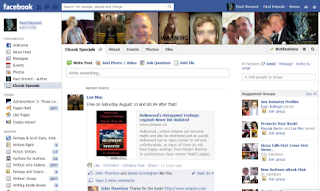
E-Book Specials Group

There are a great number of e-book groups, author groups and e-book promotional groups on Facebook. Finding good ones is tricky, finding ones that aren't just full of spam is even harder.

This new group has the advantage of being strongly moderated. Authors are encouraged to post announcement of promotions and freebie offers of their e-books but all posts are checked to ensure that everything is on topic and suitable for the group. We trying to foster a friendly and helpful atmosphere where authors can learn to maximise their potential and reach an ever growing number of potential readers.

Click here to see the Ebook Specials group.